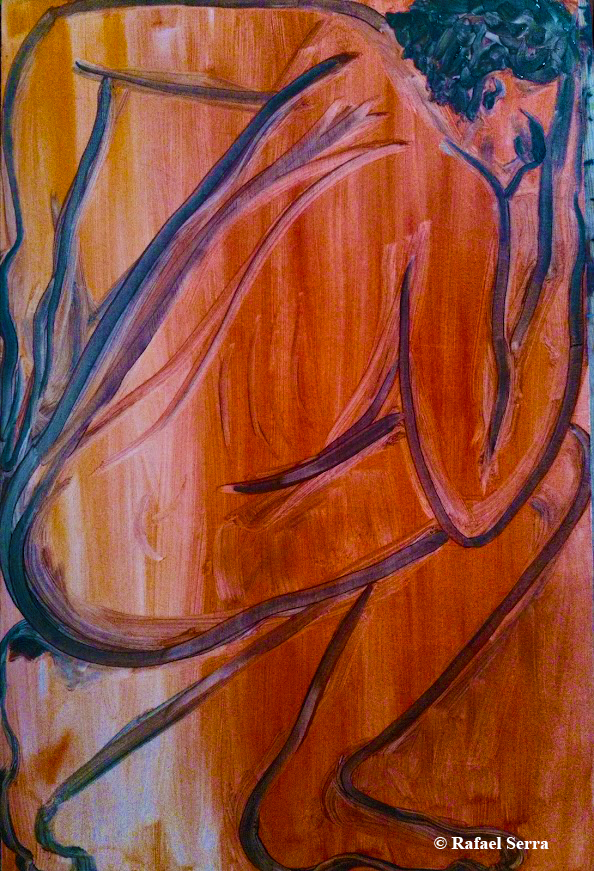
Over the years I had the unfortunate challenge of having to peel all the layers that led me to the 'schizoid position'.
Mental health fields have an interpretative frame that is mostly focused on mental contents being the main source of emotional dysregulation, or any other adverse mental state.
But they often fail to see mental phenomena through a somatic-first cause, as well as focus on the maintenance of healthy states of consciousness.
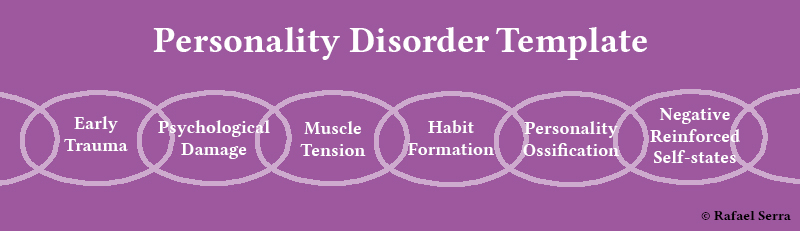
There is a complex relation between formative schemas and habits, and the accompanying symptoms (pathological or not). They seem to intertwine, inflating each other, thus 'ossifying' their own respective aspects even further.
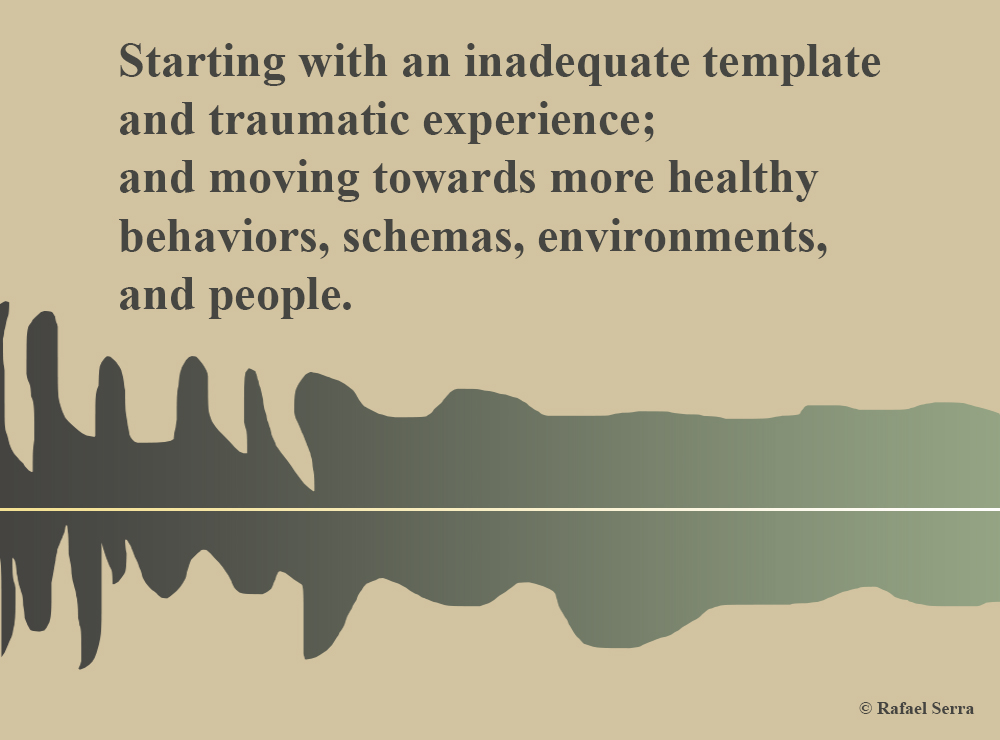
Inadequate child rearing leads to inadequate schemas, which leads to inadequate habits.
And with inadequate habits comes a defficient posture.
This is relevant for three reasons:
-First, each posture puts the muscles in a specific state;
-Second, each posture forces a skeletal structure;
-Thirdly, built up muscular-skeleton tension strains the nervous system to such an extent that it will lead to dissociation, derealization, brain fog, emotional hypersensitivity, among other symptoms.
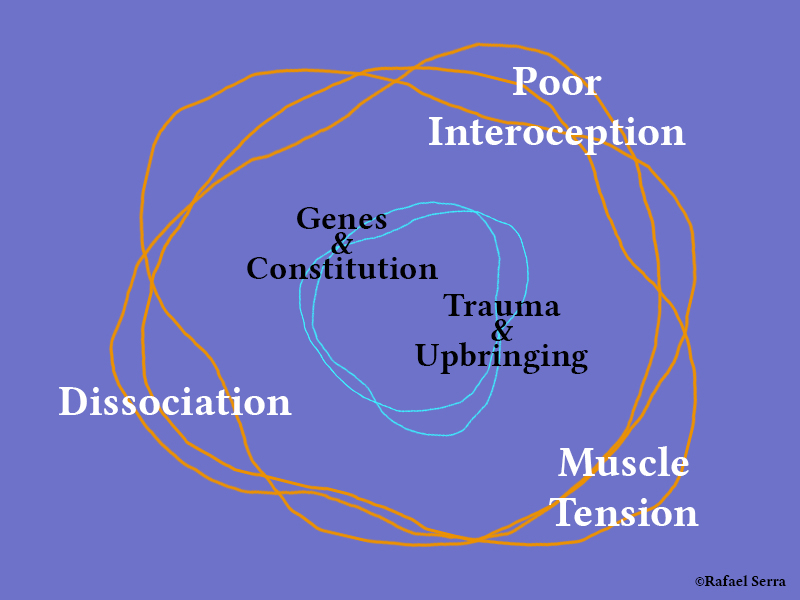
It's difficult to say which comes first: the dissociative nature that makes a person forgo one's body tension, or the body tension leading to dissociation. They're probably epiphenomena.
But there's something that seems to tie both together which are the habits, lifestyle, and recurrent lived experiences that lead to a bad posture and unhealthy physical structure.
If one analyses the schizoid position we can look how anhedonia, avolition, lethargy, low energy, and isolation, contribute and are chareteristic of the schizoid presentation.
So it has a distinctive presentation. And that presentation not only cannot be a coincidence, but its very nature has to lead to specific outcomes.
This is a key feature that needs to be accepted at the core of this analysis: which is that nothing is random - in the sense that every physical state has an accompanying mental state (and vice versa).
It's not arbitrary what position you held yourself in in respect to your mental experience (consciousness state).
------
Taking all this into consideration, we can understand how a person can be pushed into a schizoid position early on in life, or at some other point in their life.
I'm using the term 'schizoid position' to have the widest possible scope over the array of symptomatology we see associated with the personality disorder (adaptation), organization, or the self-state.
Before nomenclature there's biology and environment. We may speculate the degree to which the disorder is structural, episodic, environmental, or genetic, or some combination, but we still profit from seeing it from a biological standpoint.
Symptoms are after all, biological expressions, whether in terms of behavior, metabolism, or natural dispositions of the person.
One thing seems to be evident which is that the schizoid position is essentially a state of minimum cost maintenance.
The body is attempting to spend as little energy as possible - as little energy as it can afford.
In this light, we ought to explore in depth, in the next sections of the website, the steps and the circumstance that leads to such an extreme adaptation.